Domain-Driven Design
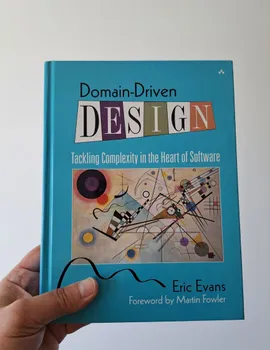
Domain-Driven Design: Tackling Complexity in the Heart of Software by Eric Evans is one of the most influential books in modern software architecture. First published in 2003, it introduced the concepts that became known as Domain-Driven Design (DDD) and significantly shaped how large, complex business systems are designed.
What the book is about
Section titled “What the book is about”The book focuses on how to handle complex business logic in large systems.
Evans introduces several concepts that work together.
1. Ubiquitous Language
Section titled “1. Ubiquitous Language”One of the most important ideas in the book.
Developers, business analysts, product owners, and domain experts should use the same language when discussing the system.
Bad Example
Business says:
“Customer Subscription”
Developers call it:
“Contract”
Database calls it:
“CustomerAgreement”
The team is now using three different concepts for the same thing.
DDD Approach
Everyone uses:
“Subscription”
Everywhere:
- Meetings
- Documentation
- Code
- Database naming
- APIs
Example:
public class Subscription{ public SubscriptionStatus Status { get; private set; }}The code reflects the business language.
This reduces misunderstandings significantly.
2. Focus on the Domain
Section titled “2. Focus on the Domain”DDD distinguishes between:
Core Domain
The part that provides competitive advantage.
Example:
For Spotify:
- Recommendation algorithms
- Music discovery
For Amazon:
- Product recommendation
- Fulfilment optimisation
For a bank:
- Risk modelling
- Loan approval logic
These areas deserve the strongest engineering effort.
Supporting Domains
Important but not differentiating.
Examples:
- Reporting
- Notifications
- Billing integrations
Generic Domains
Can often be purchased or reused.
Examples:
- Authentication
- Logging
- Email systems
The key lesson:
Put your best people on the Core Domain.
3. Building Rich Domain Models
Section titled “3. Building Rich Domain Models”Evans strongly criticises “database-centric” designs where entities are just containers of data.
Anemic Model
public class Order{ public decimal TotalAmount { get; set; }}All behaviour lives elsewhere.
Rich Domain Model
public class Order{    public void ApplyDiscount(Discount discount)    {        // Business rules here    }
    public void Confirm()    {        // Business rules here    }}
Business rules stay close to the data they govern.
4. Strategic Design
Section titled “4. Strategic Design”A large portion of the book deals with organising large systems.
Evans noticed that large organisations often have different teams using the same words with different meanings.
Example:
Sales Context
Customer = company buying products
Support Context
Customer = individual user opening tickets
Both are correct.
Trying to force one model causes confusion.
5. Bounded Contexts
Section titled “5. Bounded Contexts”One of the most important DDD concepts and arguably the foundation of modern microservices.
A Bounded Context is a boundary within which a model has a specific meaning.
Example:
Ordering Context
OrderCustomerProductBilling Context
InvoiceAccountPaymentEach context owns its language and rules.
This prevents a gigantic, tangled enterprise model.
Many modern microservice architectures are effectively implementations of Bounded Contexts.
6. Aggregates
Section titled “6. Aggregates”Aggregates help maintain consistency.
Example:
Order ├─ Order Line ├─ Order Line └─ Order LineThe Order acts as the Aggregate Root.
All modifications happen through it.
order.AddItem(product);order.RemoveItem(product);Instead of directly manipulating children.
This helps enforce business invariants.
7. Entities and Value Objects
Section titled “7. Entities and Value Objects”Entity
Has identity.
CustomerEven if properties change, it is still the same customer.
CustomerId = 123Identity matters.
Value Object
Defined only by its values.
MoneyAddressDateRangeExample:
new Money(100, "EUR")Two identical Money objects are interchangeable.
DDD encourages heavy use of Value Objects.
8. Repositories
Section titled “8. Repositories”Repositories provide access to aggregates while hiding persistence details.
IOrderRepositoryInstead of:
DbContextbeing used everywhere.
The domain remains independent of storage concerns.
9. Domain Events
Section titled “9. Domain Events”A concept that later became foundational in event-driven architectures.
Example:
OrderPlacedPaymentReceivedInvoiceGeneratedBusiness events represent meaningful things that happened.
OrderPlacedEventOther parts of the system can react to those events.
Core takeaway
Section titled “Core takeaway”The central message is:
Software should be designed around the business domain and built through close collaboration between domain experts and developers.
Many software projects fail because developers focus on technical concerns (databases, frameworks, APIs, infrastructure) while losing sight of the actual business problems they’re trying to solve.
Evans argues that:
- The business domain should drive the software design.
- Developers and domain experts should develop a shared understanding of the problem.
- The software model should reflect that understanding.
- Complexity should be managed by carefully structuring the domain and its boundaries.
The main three ideas:
- Complex software should be organised around business concepts, not technical layers.
- Developers and domain experts must share a common language and model.
- Large systems should be divided into bounded contexts with clear ownership and responsibilities.
The focus should be especially on:
- Ubiquitous Language
- Bounded Contexts
- Aggregates
- Domain Events
- Strategic Design
These five concepts deliver the majority of the long-term value from DDD and appear repeatedly in modern enterprise and microservice architectures.
In summary:
DDD is about turning business knowledge into software models that accurately represent the real-world problem being solved.
Why it matters
Section titled “Why it matters”1. It Solves the Real Problem
Section titled “1. It Solves the Real Problem”Many architecture books focus on technology.
Evans focuses on:
Understanding business complexity.
And that is usually the hardest part.
2. It Changed Modern Architecture
Section titled “2. It Changed Modern Architecture”Many current practices originated directly or indirectly from DDD:
- Microservices
- Event-driven architecture
- CQRS
- Event Sourcing
- Strategic design
- Context mapping
- Domain events
Even teams that have never read Evans often use concepts introduced in the book.
3. It Helps Large Systems Stay Maintainable
Section titled “3. It Helps Large Systems Stay Maintainable”Without DDD, large systems often become:
Big Ball of MudCharacteristics:
- Thousands of classes
- Inconsistent naming
- Duplicate business rules
- Tight coupling
- Difficult maintenance
DDD provides tools to structure complexity.
4. It Aligns Software with Business
Section titled “4. It Aligns Software with Business”One of the strongest benefits.
When business rules change:
Business Model ↓Domain Model ↓CodeChanges are easier because the software already mirrors business concepts.
5. It Encourages Better Conversations
Section titled “5. It Encourages Better Conversations”Many developers think DDD is mostly about:
- Aggregates
- Entities
- Repositories
Evans would probably say the most important part is:
Continuous collaboration between developers and domain experts.
The modelling conversations are often more valuable than the resulting code.