The Pragmatic Programmer
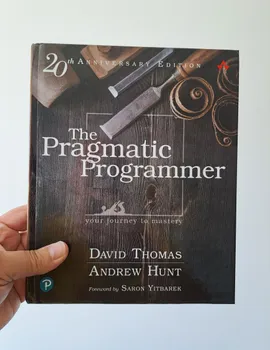
The Pragmatic Programmer: From Journeyman to Master by Andrew Hunt and David Thomas is considered one of the most influential books in software engineering. It was first published in 1999 and later updated as the 20th Anniversary Edition: The Pragmatic Programmer: Your Journey to Mastery in 2019.
What the book is about
Section titled “What the book is about”The book is a collection of practical principles, habits, and philosophies for becoming a professional software developer.
It is not primarily about:
- Algorithms
- Design patterns
- Specific programming languages
- Frameworks
Instead, it focuses on:
1. Professional Responsibility
Section titled “1. Professional Responsibility”The authors encourage developers to take ownership of:
- Their code
- Their decisions
- Their career development
Rather than saying:
“The requirements were bad.”
A pragmatic programmer asks:
“What could I have done to identify this earlier?“
2. Continuous Learning
Section titled “2. Continuous Learning”Technology changes constantly.
The book teaches that learning should become a habit rather than an occasional activity.
The authors describe building a “knowledge portfolio”, similar to a financial portfolio:
- Invest regularly.
- Diversify knowledge.
- Continue learning throughout your career.
- Explore unfamiliar topics.
This idea is especially relevant today, where AI, LLMs, MCP, agent frameworks, and cloud technologies evolve rapidly.
3. Writing Maintainable Software
Section titled “3. Writing Maintainable Software”The book repeatedly stresses that code is read far more often than it is written.
Therefore:
- Make software easy to understand.
- Eliminate duplication.
- Reduce complexity.
- Keep components loosely coupled.
One of its most famous principles is:
DRY (Don’t Repeat Yourself)
Section titled “DRY (Don’t Repeat Yourself)”The idea is not merely avoiding duplicate code.
It means:
Every piece of knowledge should have a single authoritative representation.
This applies to:
- Code
- Documentation
- Configuration
- Business rules
- Processes
4. Managing Complexity
Section titled “4. Managing Complexity”The book recognizes a core truth:
Most software problems result from complexity rather than syntax.
To combat complexity, developers should:
- Break systems into smaller pieces.
- Keep modules independent.
- Minimize assumptions.
- Build incrementally.
The goal is software that can evolve gracefully as requirements change.
5. Effective Problem Solving
Section titled “5. Effective Problem Solving”Many chapters focus on thinking rather than coding.
Examples include:
- Understanding the real problem before proposing solutions.
- Verifying assumptions.
- Experimenting early.
- Creating prototypes.
- Seeking feedback quickly.
The authors encourage curiosity and skepticism.
A pragmatic developer asks:
- “How do I know this is true?”
- “What assumptions am I making?”
- “Is there a simpler solution?“
6. Automation and Tool Mastery
Section titled “6. Automation and Tool Mastery”The book strongly advocates automating repetitive work.
Its philosophy is:
Anything you do repeatedly should be automated.
Examples include:
- Builds
- Testing
- Deployments
- Documentation generation
- Code quality checks
This idea feels surprisingly modern because it aligns perfectly with:
- DevOps
- CI/CD
- Platform engineering
- Workflow automation
- AI-assisted development
Core takeaway
Section titled “Core takeaway”Great software developers are distinguished less by the programming languages they know and more by how they think, learn, communicate, and make decisions.
The central message is that software development is a craft, and becoming an exceptional developer requires deliberate habits, continuous learning, personal responsibility, and pragmatic decision-making.
The authors argue that there is no silver bullet:
- No language will save a poor design.
- No framework will compensate for weak thinking.
- No methodology will replace professional judgment.
Instead, great programmers:
- Think critically.
- Continuously improve their skills.
- Take ownership of outcomes.
- Make informed trade-offs.
- Adapt to change rather than resist it.
The book teaches that every developer is responsible for their own growth and the quality of their work.
A recurring theme is:
“Don’t merely write code. Build solutions, solve problems, and continuously improve the way you work.”
For someone working in AI, automation, and software engineering, this translates directly into:
- Don’t just build agents.
- Don’t just connect APIs.
- Don’t just automate workflows.
Understand the underlying business problem and create solutions that remain maintainable and adaptable over time.
Why it matters
Section titled “Why it matters”Many technical books become obsolete because technologies change.
This book remains relevant because it addresses human behaviour and software craftsmanship, not specific technologies.
Technology Changes, Principles Don’t
Section titled “Technology Changes, Principles Don’t”The world has shifted from:
- Desktop applications
- Monoliths
- Waterfall development
to:
- Cloud-native architectures
- Microservices
- Containers
- AI systems
- Agentic workflows
Yet the same challenges remain:
- Poor communication
- Technical debt
- Duplication
- Complexity
- Misunderstood requirements
The book addresses those timeless problems.
It Helps Developers Think Like Engineers
Section titled “It Helps Developers Think Like Engineers”Many developers focus on implementation.
The Pragmatic Programmer teaches you to think about:
- Trade-offs
- Risks
- Maintainability
- Business impact
In other words, it helps transition from:
“I can write code.”
to
“I can design and deliver solutions.”
It Accelerates Career Growth
Section titled “It Accelerates Career Growth”The principles are applicable at every level:
Junior Developer
Section titled “Junior Developer”Learn:
- Responsibility
- Good habits
- Clean thinking
Mid-Level Developer
Section titled “Mid-Level Developer”Learn:
- Better design decisions
- Architecture thinking
- Tool mastery
Senior Developer
Section titled “Senior Developer”Learn:
- Leadership through influence
- Long-term system maintenance
- Strategic decision-making
It Aligns Extremely Well With Modern AI Engineering
Section titled “It Aligns Extremely Well With Modern AI Engineering”For someone with your interests in:
- LLM applications
- MCP
- LangChain
- Flowise
- AI agents
- Backend engineering
the book’s lessons become particularly valuable.
For example:
| Book Principle | Modern AI Engineering Equivalent |
|---|---|
| DRY | Reusable prompts, tools, workflows |
| Orthogonality | Decoupled agents and services |
| Automation | Automated evaluation and deployment pipelines |
| Tracer Bullets | Build a minimal working agent first |
| Continuous Learning | Staying current with rapidly evolving AI ecosystems |
| Responsibility | Monitoring hallucinations, reliability, and safety |
Many AI projects fail not because of model quality, but because they violate principles the book teaches:
- Too much coupling
- Poor maintainability
- Unclear requirements
- Lack of testing
- Excessive complexity
In summary:
The essence of The Pragmatic Programmer is not “how to program.”
It is:
How to think like a professional software developer.
The book teaches that mastery comes from:
- Taking responsibility.
- Continuously learning.
- Managing complexity.
- Building maintainable systems.
- Automating repetitive work.
- Solving problems pragmatically rather than dogmatically.