Cloud Native Patterns
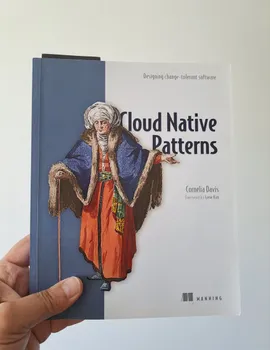
Cloud Native Patterns: Designing Change-Tolerant Software by Cornelia Davis is widely regarded as one of the foundational books for understanding cloud-native architecture beyond just Kubernetes, containers, or microservices. The book’s central argument is that cloud-native is primarily about designing software that embraces constant change, rather than simply deploying software on the cloud.
What the book is about
Section titled “What the book is about”The book provides a practical architecture guide for building resilient, scalable, continuously evolving applications.
It is structured around two major concepts:
1. Understanding the Cloud-Native Context
Section titled “1. Understanding the Cloud-Native Context”Before discussing patterns, Davis explains:
- What “cloud-native” really means
- The operational realities of modern cloud platforms
- Why traditional architectural assumptions break down
- The role of platforms such as Kubernetes and Cloud Foundry
She establishes that cloud-native systems must be designed for:
- Elastic scaling
- Fault tolerance
- Continuous delivery
- Rapid evolution
2. The Core Cloud-Native Patterns
Section titled “2. The Core Cloud-Native Patterns”The bulk of the book focuses on patterns that make software change-tolerant.
Key examples include:
Stateless Services
Applications should avoid storing session state locally.
Benefits:
- Easy scaling
- Fast replacement of failed instances
- Load balancing becomes trivial
Application Redundancy
Run multiple copies of services.
Benefits:
- High availability
- Fault tolerance
- Seamless upgrades
Externalized Configuration
Configuration should live outside application binaries.
Benefits:
- Environment portability
- Faster deployments
- Easier operations
This aligns closely with the Twelve-Factor App principles.
Service Discovery
Services should dynamically locate each other.
Instead of:
http://server123Use:
http://customer-serviceand let a discovery mechanism resolve locations.
Benefits:
- Dynamic scaling
- Infrastructure independence
Routing and Platform Networking
Applications should rely on platform-level routing instead of hardcoded network assumptions.
Retries and Control Loops
Distributed systems fail constantly.
Applications must:
- Detect failures
- Retry intelligently
- Handle transient problems automatically
Circuit Breakers
Prevent cascading failures.
Instead of:
Service A → Service B → Service Ccausing a complete outage when C fails,
Circuit Breakers:
- fail fast
- protect resources
- allow recovery
Observability and Troubleshooting
In a distributed environment:
- Logs become distributed
- Traces become essential
- Metrics become critical
The book introduces patterns that eventually influenced modern observability practices.
Event-Driven Architectures
One of the strongest sections.
Davis argues that systems often become more resilient when services communicate through events rather than tightly coupled synchronous API calls.
Benefits:
- Loose coupling
- Better scalability
- Greater resilience
Core takeaway
Section titled “Core takeaway”If I had to reduce the entire book to a single idea, it would be:
Build systems that expect failure, change, scaling, and continuous evolution as normal operating conditions.
Traditional enterprise applications often assume:
- Servers are stable
- Networks are reliable
- Deployments are infrequent
- Infrastructure changes rarely
Cloud-native systems assume the opposite:
- Infrastructure is ephemeral
- Instances come and go
- Deployments happen continuously
- Failure is inevitable
- Scaling is dynamic
Davis teaches that software should be designed around these realities from day one.
A second major takeaway is:
Cloud-native architecture is more about the “how” and “why” than the “where”.
Simply moving an application to AWS, Azure, or GCP does not make it cloud-native. A monolithic application running in Kubernetes can still be fundamentally non-cloud-native if it doesn’t embrace cloud-native patterns.
Why it matters
Section titled “Why it matters”1. It Explains the “Why” Behind Kubernetes
Section titled “1. It Explains the “Why” Behind Kubernetes”Many engineers learn:
- Docker
- Kubernetes
- Istio
- Helm
without understanding the architectural principles those tools support.
This book explains:
Why these tools exist and what problems they solve.
Once you understand the patterns, platform technologies make much more sense.
2. It Bridges Architecture and Operations
Section titled “2. It Bridges Architecture and Operations”One of the historical gaps in software engineering was:
Developers buildOperations runCloud-native systems blur that boundary.
The book teaches architectural decisions that directly impact:
- Reliability
- Deployability
- Scalability
- Operational cost
This is why it’s popular among:
- Architects
- Platform engineers
- DevOps engineers
- SREs
3. The Patterns Are Still Relevant
Section titled “3. The Patterns Are Still Relevant”Although the book was published in 2019, most patterns remain timeless:
- Statelessness
- Service discovery
- Resilience
- Observability
- Event-driven communication
- Configuration management
The tooling evolves, but these concepts remain foundational.
4. It Helps Avoid “Cloud-Native Theatre”
Section titled “4. It Helps Avoid “Cloud-Native Theatre””Many organizations believe they are cloud-native because they have:
- Kubernetes
- Containers
- CI/CD
The book shows that true cloud-native maturity comes from architecture and operating models, not tooling.
Cloud Native Patterns teaches that successful modern systems are not designed to avoid change and failure; they are designed to thrive because change and failure are expected.