Fundamentals of Software Architecture - An Engineering Approach
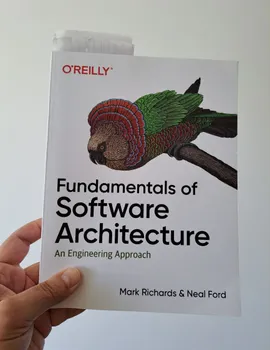
Fundamentals of Software Architecture: An Engineering Approach by Mark Richards and Neal Ford is widely considered one of the best modern introductions to software architecture because it treats architecture as an engineering discipline rather than a collection of opinions or design patterns. The book covers architectural characteristics, architecture styles, component design, trade-off analysis, and the responsibilities of a software architect.
What the book is about
Section titled “What the book is about”Part 1: Architecture Foundations
Section titled “Part 1: Architecture Foundations”The authors start by defining:
- What software architecture actually is
- The role of an architect
- Expectations of technical leaders
They introduce the concept of:
Architectural Characteristics
Section titled “Architectural Characteristics”These are quality attributes such as:
- Scalability
- Availability
- Reliability
- Security
- Performance
- Maintainability
- Testability
- Elasticity
- Fault tolerance
One of the book’s biggest lessons is:
Functional requirements tell us what a system does.
Architectural characteristics tell us how well it does it.
Part 2: Architecture Thinking
Section titled “Part 2: Architecture Thinking”The book explains how architects should think.
Topics include:
- Trade-off analysis
- Decision making
- Risk assessment
- Architectural fitness functions
- Coupling and cohesion
Rather than teaching technology-specific solutions, the authors teach a way of thinking.
This is one reason the book has aged well.
Part 3: Architecture Styles
Section titled “Part 3: Architecture Styles”This is often the most practical section.
The book examines common styles including:
- Layered Architecture
- Modular Monoliths
- Event-Driven Architecture
- Microkernel Architecture
- Service-Based Architecture
- Space-Based Architecture
- Microservices
For each style it discusses:
- Strengths
- Weaknesses
- Suitable use cases
- Architecture characteristics
The authors also introduce the idea of an architecture characteristics rating, helping architects compare alternatives objectively.
Part 4: Components
Section titled “Part 4: Components”A surprisingly valuable section.
It covers:
- Component identification
- Component boundaries
- Coupling
- Cohesion
- Granularity
Many systems fail not because the overall architecture is wrong, but because the internal component boundaries are poorly designed.
The book explains how to partition systems effectively.
Part 5: Soft Skills
Section titled “Part 5: Soft Skills”This is an area many architecture books ignore.
The authors argue that successful architects spend much of their time:
- Communicating
- Negotiating
- Influencing
- Presenting
- Facilitating decisions
Architecture is not just technical design.
You can create a brilliant architecture, but if teams cannot understand or execute it, the architecture fails.
Part 6: Evolutionary Architecture
Section titled “Part 6: Evolutionary Architecture”One of Neal Ford’s influential topics.
The idea is:
Architecture should evolve continuously rather than be fixed forever.
The book introduces:
- Fitness functions
- Automated architecture governance
- Continuous validation of architectural decisions
This aligns well with:
- DevOps
- Continuous Delivery
- Agile development
Core takeaway
Section titled “Core takeaway”The central message is:
Software architecture is about making and managing trade-offs based on business and technical requirements.
Many developers look for the “best” architecture. The authors argue that there is no universally best architecture.
Instead, architects must:
- Understand business drivers.
- Identify architectural characteristics (quality attributes).
- Evaluate trade-offs.
- Make decisions that optimise for the most important concerns.
Examples:
- Microservices improve scalability and deployment independence but increase operational complexity.
- Monoliths simplify deployment and debugging but may become harder to scale organisationally.
- Event-driven systems improve responsiveness and decoupling but add complexity in data consistency.
The book repeatedly teaches that:
Every architectural decision creates advantages and disadvantages.
The architect’s role is to understand and manage those trade-offs rather than eliminate them.
Why it matters
Section titled “Why it matters”It Bridges the Gap Between Senior Developer and Architect
Section titled “It Bridges the Gap Between Senior Developer and Architect”Many books explain design patterns.
Many books explain distributed systems.
Few explain:
How architects actually think.
This book focuses on architectural reasoning and decision-making.
For someone moving from:
- Senior Developer
- Tech Lead
- Engineering Lead
towards:
- Solution Architect
- Software Architect
- Enterprise Architect
it provides a roadmap.
It Is Technology-Agnostic
Section titled “It Is Technology-Agnostic”The concepts apply whether you’re using:
- .NET
- Java
- Python
- Node.js
- Kubernetes
- Cloud platforms
The principles remain largely the same.
That makes the knowledge durable.
It Introduces Trade-Off Thinking
Section titled “It Introduces Trade-Off Thinking”A major career progression for engineers is moving from:
“What’s the correct solution?”
to
“What is the best compromise for this situation?”
This book teaches exactly that mindset.
It Provides an Engineering Framework
Section titled “It Provides an Engineering Framework”The subtitle An Engineering Approach is important.
The authors try to make architecture less subjective by introducing:
- Metrics
- Evaluation methods
- Architecture characteristics
- Fitness functions
- Decision analysis techniques
This helps architects justify decisions objectively rather than relying on intuition alone.
In summary:
Software architecture is the discipline of selecting, communicating, and continuously validating the right trade-offs that best satisfy a system’s business and technical constraints.