Security Engineering
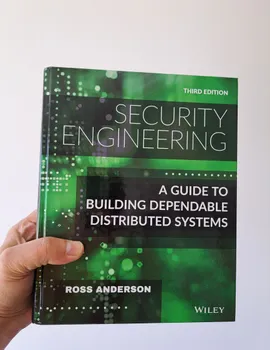
Security Engineering: A Guide to Building Dependable Distributed Systems by Ross Anderson is widely regarded as one of the foundational books in cybersecurity and security architecture. The current edition is the 3rd Edition (2020), and it covers the design, implementation, and evaluation of secure systems across a wide range of domains.
The book is fundamentally about how to build systems that remain trustworthy when intelligent adversaries actively try to break them. It is less a book about cybersecurity tools and more a book about engineering dependable socio-technical systems.
What the book is about
Section titled “What the book is about”Most security books focus on one layer:
- Cryptography
- Network security
- Operating systems
- Application security
- Compliance
Anderson takes a much broader view.
His thesis is that a secure system is not merely a collection of secure technologies. It is a combination of:
Technology+ People+ Processes+ Incentives+ Governance+ Economics= Real SecurityThe book examines security across many domains:
- Banking systems
- Payment networks
- Telecommunications
- Military systems
- Healthcare
- Critical infrastructure
- Cloud and distributed systems
- Privacy and surveillance
Rather than asking:
“How do I secure a server?”
the book asks:
“How do I build an entire system that continues to function correctly despite accidents, failures, abuse, fraud, and attack?”
That is a much broader engineering question.
Core takeaway
Section titled “Core takeaway”The single most important lesson is:
Security is not primarily a technical problem. It is a systems problem.
Many engineers naturally think:
Strong encryption = secure systemAnderson repeatedly demonstrates that reality looks more like:
Weak incentives+ Poor usability+ Operational mistakes+ Misaligned trust assumptions= Insecure systemEven if the cryptography is perfect.Throughout the book, you see examples where:
- The mathematics is sound.
- The technology works.
- The security still fails.
Why?
Because the real world introduces:
- Human error
- Incentive problems
- Business pressures
- Organisational boundaries
- Operational complexity
This is one of the reasons the book remains relevant decades after publication.
Technology changes.
Human behaviour changes slowly.
A second major takeaway
Section titled “A second major takeaway”Security is about adversaries
Section titled “Security is about adversaries”Traditional software engineering asks:
“What happens if the user makes a mistake?”
Security engineering asks:
“What happens if the user is actively trying to exploit the system?”
This changes everything.
For example:
In normal engineering:
Input validation prevents errors.In security engineering:
Input validation prevents attackersfrom gaining control of the system.The distinction sounds small but it changes the entire mindset.
Every design decision becomes:
- Who could attack this?
- What do they gain?
- How much effort are they willing to spend?
- What assumptions am I making?
This adversarial thinking is central to the book.
A third major takeaway
Section titled “A third major takeaway”Trust is the most important architectural decision
Section titled “Trust is the most important architectural decision”Anderson repeatedly analyses systems through trust relationships.
For any system, he asks:
- Who is trusted?
- Why are they trusted?
- What happens if they misbehave?
- Can trust be minimised?
Consider a modern SaaS platform:
User ↓Frontend ↓API Gateway ↓Microservices ↓DatabaseMany architects focus on:
- Frameworks
- Databases
- Network topology
Anderson would first ask:
Where are the trust boundaries?Because most security failures arise from misplaced trust.
For example:
- Trusting user input.
- Trusting another service.
- Trusting a third-party vendor.
- Trusting an administrator.
- Trusting a cloud provider.
The book teaches you to think explicitly about trust rather than assuming it.
Why it matters
Section titled “Why it matters”1. It teaches architectural thinking
Section titled “1. It teaches architectural thinking”Many security resources focus on vulnerabilities.
Examples:
- SQL injection
- XSS
- CSRF
- Buffer overflows
These are important.
But Anderson teaches something more valuable:
Why systems become vulnerable in the first place.
You learn how to reason about system design rather than memorising attack patterns.
2. It applies to modern cloud systems
Section titled “2. It applies to modern cloud systems”Although some examples are older, the principles map directly to:
- Microservices
- Kubernetes
- Cloud-native applications
- SaaS platforms
- API ecosystems
For example, when designing an API platform, the book’s questions remain exactly the same:
- How is identity established?
- How is authority delegated?
- What happens when a component fails?
- What happens when a component is compromised?
Those questions never become obsolete.
3. It is surprisingly relevant to AI systems
Section titled “3. It is surprisingly relevant to AI systems”Modern AI systems are highly distributed:
User ↓Agent ↓LLM ↓Tools ↓Databases ↓External APIsAnderson’s approach would force you to ask:
- Can the model be manipulated?
- Which components are trusted?
- What authority does the agent possess?
- Can tools be abused?
- What happens if one service returns malicious data?
- How should permissions be delegated?
These are rapidly becoming the core security questions of agentic systems.
4. It explains failures that technology alone cannot
Section titled “4. It explains failures that technology alone cannot”One of the book’s unique contributions is security economics.
Anderson argues that many security failures occur because:
The party making the decisionis not the party bearing the risk.Examples include:
- Software vendors
- Payment networks
- Social media platforms
- Telecom providers
This explains why some insecure systems persist for years even when the technical fix is obvious.
That perspective is still rare in technical books.
In summary:
Security Engineering teaches that secure systems emerge from correctly designed trust relationships, incentives, and operational processes, not merely from cryptography, firewalls, or security tools.