Monolith to Microservices
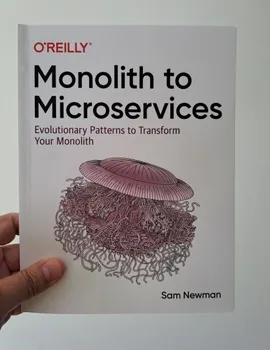
Sam Newman’s Monolith to Microservices: Evolutionary Patterns to Transform Your Monolith is a well‑known, highly practical guide focused on incrementally evolving monolithic systems into microservices. It’s not about “rewriting everything,” but about controlled, evolutionary decomposition backed by proven patterns.
What the book is about
Section titled “What the book is about”The book provides:
- Migration patterns (Strangler Fig, Branch by Abstraction, Parallel Run, UI Composition)
- Database decomposition strategies (Split Table, Tracer Write, Synchronize Data in Application)
- Organizational and cultural guidance for teams transitioning to microservices
- Incremental extraction techniques to avoid big‑bang rewrites
- Operational considerations like monitoring, testing, and handling growing pains
Key ideas
Section titled “Key ideas”- Independent deployability is the single most important property of a microservice.
- Strangler Fig pattern is the primary safe migration approach.
- Database decomposition is unavoidable for true autonomy.
- Incremental migration is mandatory — big‑bang rewrites fail.
- Domain‑Driven Design helps identify service boundaries.
Structure of the book
Section titled “Structure of the book”The book is organized around the migration lifecycle:
- Just Enough Microservices — definitions, cohesion, coupling, domain boundaries
- Planning a Migration — goals, trade‑offs, organizational change
- Splitting the Monolith — migration patterns and refactoring strategies
- Decomposing the Database — ownership, synchronization, transactions, sagas
- Growing Pains — operational complexity, testing, monitoring
- Closing Words — sustaining productivity as the architecture evolves
Core takeaway
Section titled “Core takeaway”The core takeaway is that microservices are a means to an end, not the goal. Newman emphasizes that you must articulate the outcome you want before decomposing anything.
Why it matters
Section titled “Why it matters”The book aligns extremely well with:
- Modernizing legacy systems before layering AI/LLM capabilities
- Designing autonomous services that can host AI agents or workflows
- Building event‑driven architectures that integrate with n8n, Flowise, or MCP
- Understanding the organizational side of architecture change