Building Maintainable Software
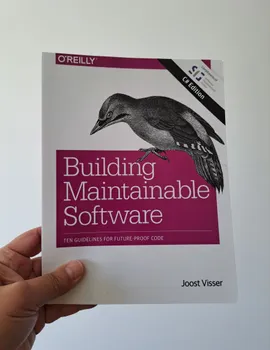
Building Maintainable Software, C# Edition: Ten Guidelines for Future-Proof Code by Joost Visser and his colleagues from the Software Improvement Group (SIG). The book is based on the analysis of hundreds of real-world software systems and aims to provide practical, measurable guidelines for improving software maintainability.
What the book is about
Section titled “What the book is about”The book is essentially a maintainability handbook for developers and technical leaders.
Rather than discussing design patterns, DDD, CQRS, or advanced architecture styles, it focuses on foundational practices that make code easier to:
- Understand
- Change
- Extend
- Debug
- Test
- Transfer between team members
The authors define maintainability as the ability to modify software efficiently and safely over time.
1. Code-Level Maintainability
Section titled “1. Code-Level Maintainability”Several chapters focus on individual methods and classes.
Examples:
Write Short Units
Methods should be small enough that a developer can understand them quickly.
Instead of:
public void ProcessOrder(...){ // 200 lines}Use:
public void ProcessOrder(...){ ValidateOrder(); CalculatePrice(); ReserveInventory(); CreateInvoice();}The goal is to reduce cognitive load.
Write Simple Units
The book strongly discourages excessive branching and complex decision trees.
Bad:
if (...){ if (...) { if (...) { ... } }}Complexity directly impacts maintainability.
The authors encourage measuring complexity and keeping it under control.
Write Code Once
Avoid duplication.
Copy-paste programming creates hidden maintenance costs.
When a bug is fixed in one location but not the others, defects emerge.
2. Class and Module Design
Section titled “2. Class and Module Design”The next set of guidelines focuses on creating coherent modules.
Keep Unit Interfaces Small
Classes with many parameters and many public methods tend to become difficult to understand and use.
Instead of:
CreateUser( string firstName, string lastName, string address, string city, string zip, string country);Use:
CreateUser(UserInfo user);Smaller interfaces are easier to evolve.
Separate Concerns
A class should have a focused responsibility.
Bad example:
OrderServiceHandles:
- Validation
- Database access
- Reporting
- Email sending
- Logging
Better:
OrderValidatorOrderRepositoryEmailNotifierReportGeneratorYou can clearly see the influence of SOLID principles here.
3. Architecture-Level Maintainability
Section titled “3. Architecture-Level Maintainability”The book then zooms out from classes to systems.
Loosely Coupled Components
Changes in one component should not create cascading effects elsewhere.
For example:
UI |API |Domain |Infrastructureis generally easier to maintain than a mesh of dependencies where every component depends on every other component.
Balanced Components
The authors observed that healthy systems typically avoid:
One giant component Hundreds of tiny fragmented components
Both extremes create maintenance problems.
A system should have reasonably balanced subsystems.
Keep the Codebase Small
One of the most overlooked ideas in the book:
The best code is often the code you never write.
Every line of code carries future maintenance cost.
The authors encourage:
- Removing dead code
- Removing obsolete features
- Reusing frameworks where appropriate
- Simplifying solutions
4. Process and Quality
Section titled “4. Process and Quality”The final guidelines focus on sustainable engineering practices.
Automate Tests
Manual testing does not scale.
Automated tests serve as:
- Change detectors
- Documentation
- Safety nets
A maintainable codebase is difficult to achieve without them.
Write Clean Code
The book aligns with many ideas from Robert C. Martin’s Clean Code:
- Meaningful names
- Consistent conventions
- Removal of code smells
- Readable code
The difference is that SIG attempts to connect these ideas to measurable maintainability outcomes rather than treating them as stylistic preferences.
Core takeaway
Section titled “Core takeaway”The central message is:
Software maintainability is not a matter of opinion. It can be measured, improved, and managed through a small set of concrete coding and architectural practices.
The authors argue that most software projects become expensive and risky not because of incorrect functionality, but because the codebase gradually becomes harder to understand, modify, and extend. Maintainability should therefore be treated as a first-class quality attribute, just like security, performance, and reliability.
The book distills maintainability into ten practical guidelines:
- Write short units of code
- Write simple units of code
- Write code once
- Keep unit interfaces small
- Separate concerns in modules
- Couple architecture components loosely
- Keep architecture components balanced
- Keep your codebase small
- Automate tests
- Write clean code
If you remember only one thing from the book, it is this:
Future development speed depends more on the health of the existing codebase than on the talent of individual developers.
Why it matters
Section titled “Why it matters”1. Most Software Costs Occur After Release
Section titled “1. Most Software Costs Occur After Release”Many developers focus on writing code that works today.
Businesses care about:
How much will it cost to modify this system in three years?
Maintainable code reduces long-term ownership costs.
2. Maintainability Directly Impacts Delivery Speed
Section titled “2. Maintainability Directly Impacts Delivery Speed”A common misconception:
Messy code = faster deliveryReality:
Messy code = faster todayMessy code = slower every future releaseAs technical debt accumulates:
Features take longer Bugs increase Testing becomes harder Refactoring becomes risky
3. The Guidelines Are Evidence-Based
Section titled “3. The Guidelines Are Evidence-Based”One of the book’s strengths is that it is not primarily opinion-driven.
The recommendations were derived from large-scale analysis of real software systems by SIG consultants.
This makes the book particularly valuable for technical leads and architects who need objective reasoning when discussing code quality.
4. It Connects Code Quality to Business Outcomes
Section titled “4. It Connects Code Quality to Business Outcomes”Many books explain how to write cleaner code.
This book explains why executives should care:
- Reduced maintenance costs
- Faster development
- Lower defect rates
- Easier onboarding
- Longer software lifespan
In summary:
The book teaches that maintainable systems emerge from controlling complexity at every level: methods, classes, modules, architecture, and development process. The ten guidelines provide a practical framework for keeping software adaptable, understandable, and cost-effective over its entire lifetime.
For a C# developer, the most valuable chapters are usually Write Simple Units, Separate Concerns, Couple Components Loosely, and Automate Tests, because those four principles tend to produce the largest long-term impact on enterprise .NET codebases.