Continuous API Management
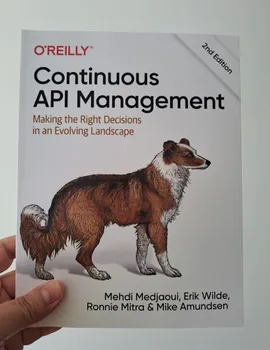
Continuous API Management: Making the Right Decisions in an Evolving Landscape by Mehdi Medjaoui, Erik Wilde, Ronnie Mitra, and Mike Amundsen is one of the most important books in the modern API ecosystem. It’s effectively the API‑product‑management playbook used across enterprises, API platform teams, and organizations scaling their API landscapes.
What the book is about
Section titled “What the book is about”1. API management fundamentals
Section titled “1. API management fundamentals”It defines API management as a combination of governance, product thinking, and landscape design, emphasizing why API ecosystems become complex as they scale.
2. API governance
Section titled “2. API governance”The authors introduce governance patterns such as:
- Interface supervision
- Machine‑driven governance
- Collaborative governance
These help organizations avoid chaos without slowing teams down.
3. API as a product
Section titled “3. API as a product”This is the philosophical core:
- Design thinking
- Developer experience
- Customer onboarding
- Business viability
It reframes APIs as customer‑facing products with measurable outcomes.
4. The Ten Pillars of API Product Work
Section titled “4. The Ten Pillars of API Product Work”Strategy, design, documentation, development, testing, deployment, security, monitoring, discovery/promotion, and change management.
5. Continuous API improvement
Section titled “5. Continuous API improvement”How to evolve APIs safely:
- Release lifecycle
- Change velocity
- Coupling costs
- Incremental improvement
6. API product lifecycle
Section titled “6. API product lifecycle”Five stages:
- Create
- Publish
- Realize
- Maintain
- Retire
7. API teams
Section titled “7. API teams”Covers roles, scaling patterns, Conway’s Law, Dunbar’s numbers, and cultural models for API organizations.
8. API landscapes
Section titled “8. API landscapes”One of the strongest chapters:
- API archaeology
- Platform principles
- The Eight Vs (Variety, Vocabulary, Volume, Velocity, Vulnerability, Visibility, Versioning, Volatility)
Core takeaway
Section titled “Core takeaway”The book argues that APIs must be treated as products, not technical artifacts — and therefore require governance, lifecycle management, maturity models, and dedicated teams. This is the same shift that transformed CI/CD, DevOps, and platform engineering: APIs become long‑lived assets that evolve continuously.
Why it matters
Section titled “Why it matters”- It’s technology‑agnostic — applies to REST, GraphQL, gRPC, event‑driven APIs.
- It’s used by API platform teams at large enterprises (banks, telcos, SaaS).
- It provides maturity models for both individual APIs and entire landscapes.
- It’s one of the few books that connects API strategy, governance, product management, and organizational design.