Programming Microsoft Visual C# 2005
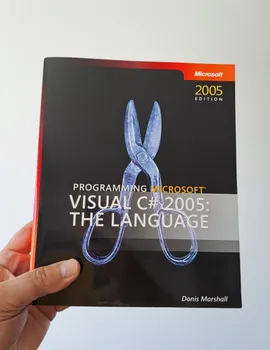
Programming Microsoft Visual C# 2005: The Language by Donis Marshall is a Microsoft Press reference book focused on mastering the C# 2.0 language and the language features introduced with Visual Studio 2005 and .NET Framework 2.0. It was published in 2006 and intended for both intermediate and experienced developers.
What the book is about
Section titled “What the book is about”The book is primarily a deep dive into the C# language itself, rather than a guide to building specific applications or learning the .NET Framework libraries in detail.
It covers:
- C# syntax and language fundamentals
- Object-oriented programming concepts
- Classes
- Structs
- Interfaces
- Inheritance
- Polymorphism
- Exception handling
- Collections and data structures
- Generics (one of the major additions in C# 2.0)
- Iterators and enumerators
- Delegates and anonymous methods
- Reflection and metadata
- Debugging techniques
- Threading and synchronization
- Memory management and runtime behaviour
The emphasis is on understanding how the language works under the hood and how to use its features effectively in real-world software development.
Core takeaway
Section titled “Core takeaway”If I had to summarize the entire book in one sentence:
Learn C# as a language and platform technology, not merely as a tool for writing code.
The author’s approach is to move developers beyond syntax memorization and toward understanding:
- Why language features exist
- When to use them
- The trade-offs involved
- How the CLR (.NET runtime) executes C# code
Key lessons include:
1. Strong object-oriented design matters
Section titled “1. Strong object-oriented design matters”The book repeatedly reinforces that good software comes from properly modelling behaviour through:
- Encapsulation
- Inheritance
- Composition
- Polymorphism
Rather than simply writing procedural code in C#.
2. Type safety is a major strength
Section titled “2. Type safety is a major strength”A central theme is leveraging the type system to catch errors early.
The introduction of Generics in C# 2.0 was revolutionary because it enabled:
List<Customer>instead of:
ArrayListThis eliminated many runtime casting errors and improved performance.
3. The runtime is as important as the language
Section titled “3. The runtime is as important as the language”The book teaches that professional .NET developers should understand:
- CLR execution
- Metadata
- Reflection
- Garbage collection
- Thread synchronization
instead of treating them as invisible implementation details.
4. Development is not just coding
Section titled “4. Development is not just coding”Considerable attention is given to:
- Debugging
- Diagnostics
- Exception handling
- Code quality
because production software spends far more time being maintained than initially written.
Why it mattered in 2005
Section titled “Why it mattered in 2005”When Visual C# 2005 was released, it introduced several language features that changed how .NET applications were built.
Notable additions included:
- Generics
- Anonymous methods
- Iterators (yield)
- Partial classes
- Improved debugging support
- Better collection frameworks
At the time, this book helped developers transition from:
- C# 1.x and .NET 1.1
to
- C# 2.0 and .NET 2.0
which was one of the biggest evolutionary steps in the language’s history.
Why it still matters today
Section titled “Why it still matters today”Although the syntax is dated compared to modern C# (C# 12/13 era), many of the concepts remain foundational.
Still relevant
✅ Object-oriented design
✅ Generics
✅ Delegates
✅ Collections
✅ Exception handling
✅ Reflection
✅ Threading fundamentals
✅ Memory management concepts
These ideas are still used by modern ASP.NET Core, Entity Framework, Blazor, and Azure applications.
Less relevant today
❌ Visual Studio 2005 tooling
❌ Anonymous methods (mostly replaced by lambdas)
❌ Pre-LINQ coding patterns
❌ Older collection APIs
❌ .NET Framework-specific practices
Bottom line
Section titled “Bottom line”The book’s central message is:
Mastering C# requires understanding both the language constructs and the .NET runtime that executes them.
While many code examples are now legacy-era .NET, the principles behind type safety, object-oriented design, generics, reflection, debugging, and runtime behaviour remain highly valuable even for modern C# and .NET developers.