Strategic Monoliths and Microservices
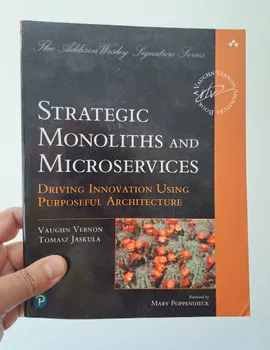
Strategic Monoliths and Microservices: Driving Innovation Using Purposeful Architecture (Addison‑Wesley, 2021) by Vaughn Vernon and Tomasz Jaskuła is a well‑known, highly regarded software architecture book.
What the book is about
Section titled “What the book is about”The book argues that both monoliths and microservices can be strategic, depending on business goals, domain complexity, team structure, and organizational maturity. It teaches how to design modular monoliths, how to evolve them into microservices when appropriate, and how to use DDD + event‑driven architecture as the backbone of purposeful modernization.
Core takeaway
Section titled “Core takeaway”Help organizations make intentional architectural decisions instead of blindly following the “microservices everywhere” trend.
Why it matters
Section titled “Why it matters”- It pushes back against hype-driven architecture and emphasizes business‑aligned decision making.
- It blends DDD, event‑storming, context mapping, and architecture patterns into a single strategic framework.
- It provides practical migration paths: modular monolith → microservices, or even “Big Ball of Mud” → microservices.
Key themes
Section titled “Key themes”- Strategic architecture — architecture as a business capability, not a tech choice.
- Domain‑Driven Design — bounded contexts, core domains, contextual expertise.
- Event‑storming — rapid learning and discovery using events-first modeling.
- Modular monoliths — how to build monoliths “like you mean it.”
- Microservices evolution — when and how to split a monolith.
- Event‑driven architecture — messaging, CQRS, event sourcing.
- Quality attributes — using attributes to drive architectural decisions.
Structure of the book
Section titled “Structure of the book”The book is organized into four major parts:
- Transformational Strategic Learning — business goals, digital transformation, Conway’s Law, strategic tools.
- Driving Business Innovation — DDD fundamentals, contextual expertise, domain modeling.
- Events‑First Architecture — architectural styles, event-driven systems, CQRS, serverless.
- Two Paths for Purposeful Architecture — building monoliths well, migrating to microservices intentionally.