Clean Agile
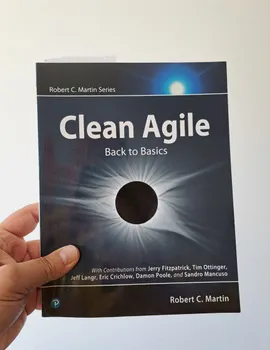
Clean Agile: Back to Basics by Robert C. Martin (“Uncle Bob”) is one of the better books for understanding what Agile originally meant before it became diluted by frameworks, certifications, and organisational bureaucracy. Martin was one of the original signatories of the Agile Manifesto, so the book is partly a history lesson and partly a correction of common misconceptions about Agile.
What the book is about
Section titled “What the book is about”The book can be divided into several major themes.
1. The Origins of Agile
Section titled “1. The Origins of Agile”Martin explains how software development looked before Agile:
- Large upfront designs
- Heavy documentation
- Long project cycles
- High failure rates
He describes the emergence of:
- Extreme Programming (XP)
- Scrum
- Agile Manifesto
and explains why the original authors created Agile in the first place.
Key lesson
Section titled “Key lesson”Agile was created to solve real delivery problems, not to create a new management methodology.
2. Agile Values and Principles
Section titled “2. Agile Values and Principles”Martin revisits the Agile Manifesto and emphasises the original values:
- Individuals and interactions over processes and tools
- Working software over comprehensive documentation
- Customer collaboration over contract negotiation
- Responding to change over following a plan
He argues that these principles remain just as relevant today as when they were written.
Key lesson
Section titled “Key lesson”If a process violates the Agile values, it is probably not Agile, regardless of what it’s called.
3. Scrum and Team Organisation
Section titled “3. Scrum and Team Organisation”The book explains Scrum from the perspective of its original intent:
- Small teams
- Product ownership
- Sprint planning
- Reviews
- Retrospectives
However, Martin is careful to point out that:
Scrum alone does not make a team Agile.
Scrum is merely a management framework. The real success comes from combining Scrum with sound engineering practices.
Key lesson
Section titled “Key lesson”Scrum organises work. Engineering practices enable delivery.
4. Professional Software Craftsmanship
Section titled “4. Professional Software Craftsmanship”This is arguably the strongest part of the book.
Martin argues that developers are professionals and should take responsibility for:
- Code quality
- Testing
- Maintainability
- Reliability
He rejects the idea that deadlines justify poor code.
Key lesson
Section titled “Key lesson”Technical debt eventually slows every team down.
Quality is not a luxury. It is a business requirement.
5. Technical Practices
Section titled “5. Technical Practices”The book strongly advocates:
Test-Driven Development (TDD)
Section titled “Test-Driven Development (TDD)”Write tests first, then production code.
Benefits:
- Better design
- Safer refactoring
- Higher confidence
Refactoring
Section titled “Refactoring”Continuously improve code structure without changing behaviour.
Benefits:
- Reduced complexity
- Easier maintenance
Pair Programming
Section titled “Pair Programming”Two developers solving problems together.
Benefits:
- Better decisions
- Knowledge sharing
- Fewer defects
Continuous Integration
Section titled “Continuous Integration”Integrate code frequently and verify automatically.
Benefits:
- Faster feedback
- Fewer integration problems
Martin presents these not as optional practices but as part of the Agile foundation.
Core takeaway
Section titled “Core takeaway”The central message is:
Agile is not Scrum, ceremonies, boards, story points, or tools. Agile is a set of values, principles, disciplines, and technical practices designed to help teams deliver working software continuously and professionally.
Martin argues that many organisations claim to be Agile while ignoring the practices that make Agile work. They keep the meetings but abandon the engineering discipline.
In his view, true Agile requires:
- Small, collaborative teams
- Frequent delivery of working software
- Continuous feedback
- Technical excellence
- Professionalism and craftsmanship
- Adaptability over rigid planning
A recurring theme throughout the book is that Agility without engineering discipline is ineffective. Practices such as:
- Test-Driven Development (TDD)
- Refactoring
- Simple Design
- Pair Programming
- Continuous Integration
are not optional extras. They are foundational to sustainable Agile development.
Why it matters
Section titled “Why it matters”1. It Separates Agile from Agile Theatre
Section titled “1. It Separates Agile from Agile Theatre”Many organisations perform Agile ceremonies while retaining:
- Command-and-control management
- Large batch delivery
- Poor engineering practices
- Endless planning
The book helps distinguish:
Real Agile
- Continuous value delivery
- Fast feedback
- High quality
from:
Agile Theatre
- Standups
- Jira boards
- Velocity reports
- Scrum titles
without meaningful improvement.
2. It Reconnects Agile with Engineering
Section titled “2. It Reconnects Agile with Engineering”Many modern Agile discussions focus heavily on:
- Frameworks
- Scaling models
- Metrics
- Processes
Martin redirects attention toward software craftsmanship.
For engineers, this is extremely valuable because it reminds us that:
Agile succeeds because of good engineering, not because of meetings.
3. It Explains the “Why”
Section titled “3. It Explains the “Why””Many Agile books teach mechanics.
This book explains:
- Why Agile emerged
- Why certain practices exist
- Why teams struggle without them
Understanding the reasoning helps teams adapt intelligently instead of following rules mechanically.
4. It Is Relevant for Modern Teams
Section titled “4. It Is Relevant for Modern Teams”Even in today’s world of:
- Cloud-native development
- DevOps
- AI-assisted coding
- Continuous deployment
the core ideas remain applicable:
- Short feedback loops
- Quality-first development
- Small increments
- Customer collaboration
- Continuous learning
These principles underpin modern engineering organisations.
The most valuable insight from the book is probably:
Agile is primarily an engineering discipline, not a project-management methodology.
Many teams optimise backlog management, sprint planning, and reporting while neglecting:
- Automated tests
- Refactoring
- Clean architecture
- Continuous integration
Martin argues that this imbalance is one of the major reasons Agile transformations fail.
In summary:
Deliver small increments of working software frequently, maintain high technical quality, and use fast feedback to continuously adapt. That is Agile.