Building Microservices
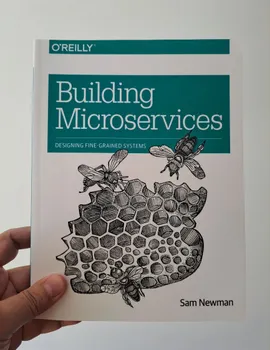
Building Microservices – Designing Fine‑Grained Systems by Sam Newman is one of the foundational books in modern microservices architecture. It’s widely regarded as a practical, experience‑driven guide for architects and engineers who want to design, evolve, and operate microservices in real-world environments.
What the book is about
Section titled “What the book is about”1. Core microservices principles
Section titled “1. Core microservices principles”- Independent deployability
- Business-domain boundaries
- Autonomous data ownership
- Organizational alignment (Conway’s Law)
2. Modeling microservices
Section titled “2. Modeling microservices”- Cohesion vs coupling
- Domain-driven design (bounded contexts, aggregates)
- Event storming
3. Splitting monoliths safely
Section titled “3. Splitting monoliths safely”- Incremental decomposition
- Strangler Fig pattern
- Parallel run and feature toggles
4. Communication styles
Section titled “4. Communication styles”- Synchronous (REST, gRPC)
- Asynchronous (events, messaging)
- Request-response vs event-driven trade-offs
5. Deployment & operations
Section titled “5. Deployment & operations”- CI/CD pipelines
- Containers & Kubernetes
- Serverless considerations
6. Testing & observability
Section titled “6. Testing & observability”- Contract testing
- Distributed tracing
- Log aggregation
- Monitoring strategies
7. Security
Section titled “7. Security”- User-to-service and service-to-service models
- Identity propagation
- API gateway security
8. Organizational aspects
Section titled “8. Organizational aspects”- Team boundaries
- Ownership
- Microservices as socio-technical systems
Core takeaway
Section titled “Core takeaway”It’s a holistic, practice-oriented manual covering modeling, integration, deployment, testing, observability, organizational alignment, and security in microservices — with both conceptual clarity and actionable patterns.
Why it matters
Section titled “Why it matters”- It reinforces domain-driven decomposition, which is crucial when designing AI-driven or workflow-driven systems.
- It provides integration patterns that map directly to your work with agents, orchestrators, and distributed workflows.
- It covers observability and security, which are essential for production-grade AI/microservice platforms.
- It helps you design scalable backend architectures for your Daily Scrum app or future enterprise systems.