Learning Domain-Driven Design
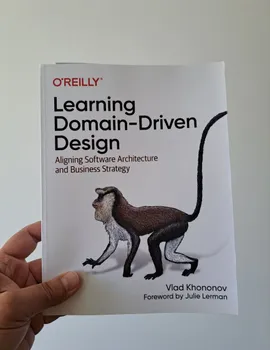
Learning Domain-Driven Design: Aligning Software Architecture and Business Strategy by Vlad Khononov is one of the most practical and modern introductions to Domain-Driven Design (DDD). It takes Eric Evans’ original DDD concepts and explains them in a way that is much easier to apply in real-world software projects. The book focuses on aligning software design with business needs rather than treating software architecture as a purely technical exercise.
What the book is about
Section titled “What the book is about”The book walks through DDD from both a strategic and tactical perspective. It teaches how to understand a business, model its complexity, and implement that model in software.
Part 1: Strategic Design
Section titled “Part 1: Strategic Design”This section focuses on understanding the business.
Topics include:
- Business domains
- Competitive advantage
- Subdomains
- Domain experts
- Bounded Contexts
- Context Mapping
The question being answered is:
“How should we divide a large business problem into manageable pieces?”
Part 2: Tactical Design
Section titled “Part 2: Tactical Design”This is where software implementation starts.
Topics include:
- Entities
- Value Objects
- Aggregates
- Domain Events
- Repositories
- Domain Services
The question becomes:
“How do we encode business rules and behaviour into software?”
One of Khononov’s strengths is explaining when each pattern should be used instead of presenting them as mandatory rules.
Part 3: Applying DDD in Practice
Section titled “Part 3: Applying DDD in Practice”This section covers:
- Introducing DDD into existing systems
- Working with legacy applications
- Incremental adoption
- Team collaboration
A valuable lesson here is that DDD is not an all-or-nothing movement.
Part 4: DDD and Other Architectural Styles
Section titled “Part 4: DDD and Other Architectural Styles”The book explores the relationship between DDD and:
- Microservices
- CQRS
- Event Sourcing
- Layered Architecture
- Hexagonal Architecture (Ports and Adapters)
A common misconception is that DDD requires microservices.
Khononov clearly explains that:
DDD is a modelling and strategic design discipline. Microservices are merely one possible deployment architecture.
Core takeaway
Section titled “Core takeaway”The single most important message is:
Software should be designed around the business domain, not around technology, databases, frameworks, or organisational structures.
Khononov argues that many software systems become difficult to evolve because teams focus primarily on technical concerns while failing to deeply understand the business they are supporting. DDD provides tools for modelling business concepts, rules, and processes directly within the software.
The key ideas include:
1. Business understanding drives architecture
Section titled “1. Business understanding drives architecture”Architecture should emerge from the complexity of the business domain.
Instead of asking:
- “Should we use microservices?”
- “Should we use CQRS?”
- “Should we use Event Sourcing?”
You first ask:
- “What business problem are we solving?”
- “What makes this business unique?”
- “Where is the complexity?“
2. Focus on the Core Domain
Section titled “2. Focus on the Core Domain”Not all parts of a system are equally important.
DDD divides the business into:
- Core Domain: the source of competitive advantage
- Supporting Subdomains: necessary but not differentiating
- Generic Subdomains: commodity capabilities
The majority of strategic investment should go into the Core Domain.
3. Shared understanding matters more than code
Section titled “3. Shared understanding matters more than code”Successful systems emerge when developers and domain experts share a common mental model.
This is achieved through:
- Collaboration
- Domain modelling
- Ubiquitous Language
The language used by business experts should be reflected directly in the software.
4. Boundaries are essential
Section titled “4. Boundaries are essential”Large systems become manageable when divided into well-defined Bounded Contexts.
Each context:
- Has its own model
- Has its own terminology
- Evolves independently
This idea heavily influences modern:
- Microservices
- Modular monoliths
- Team Topologies
- Event-driven architectures
Why it matters
Section titled “Why it matters”1. Most software failures are business failures
Section titled “1. Most software failures are business failures”Many projects succeed technically but fail to create business value.
For example:
- Clean code
- Good performance
- Modern architecture
Yet business stakeholders still complain because the software does not accurately represent the business process.
DDD addresses this gap.
2. It helps manage complexity
Section titled “2. It helps manage complexity”Complexity is the primary challenge in enterprise software.
As systems grow:
- Rules multiply
- Teams expand
- Requirements evolve
DDD provides a structured way to organise complexity rather than fighting it with technical abstractions alone.
3. It improves communication
Section titled “3. It improves communication”One of the largest sources of defects is misunderstanding.
Typical chain:
Business idea ↓Business analyst interpretation ↓Developer interpretation ↓ImplementationEach handoff introduces errors.
DDD encourages developers to work directly with domain experts and build a common language.
4. It provides a foundation for modern architecture
Section titled “4. It provides a foundation for modern architecture”Many modern architecture concepts are difficult to use correctly without DDD:
- Microservices
- Event-driven systems
- Event Sourcing
- CQRS
- Modular monoliths
DDD explains why and where boundaries should exist.
Without DDD, teams often create microservices based on technical layers rather than business capabilities.
5. It is especially valuable for AI and enterprise engineers
Section titled “5. It is especially valuable for AI and enterprise engineers”- LLM applications
- AI agents
- ASP.NET Core
- Enterprise systems
- Backend architecture
the most valuable lesson is:
Model the business first, then choose technology.
Whether you’re building:
- AI agents
- Workflow automation in n8n
- MCP-based platforms
- Enterprise APIs
the quality of the solution often depends more on understanding the domain than on choosing the perfect framework.
In summary:
The book teaches that software architecture is fundamentally a business modelling problem, and Domain-Driven Design provides the strategic and tactical tools to translate business knowledge into maintainable software.