Rust Web Programming
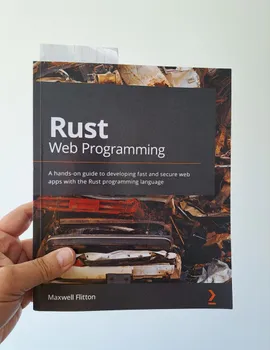
Rust Web Programming: A Hands-on Guide to Developing Fast and Secure Web Apps with the Rust Programming Language by Maxwell Flitton. The book is a practical guide that teaches web development through Rust by building real applications rather than focusing purely on language theory. It covers Rust fundamentals, web frameworks, databases, authentication, testing, and deployment.
What the book is about
Section titled “What the book is about”The book walks through the complete lifecycle of building a web application in Rust.
1. Rust Fundamentals for Web Developers
Section titled “1. Rust Fundamentals for Web Developers”The book starts by helping developers coming from dynamic languages understand:
- Ownership
- Borrowing
- Lifetimes
- Error handling
- Modules and project organisation
Rather than covering Rust academically, it explains these concepts in the context of web development.
2. Building Web Servers
Section titled “2. Building Web Servers”The author introduces popular Rust web frameworks such as:
- Actix Web
- Rocket
- Warp
and demonstrates how web servers, routing, requests, and responses work in Rust.
3. APIs and REST Services
Section titled “3. APIs and REST Services”A major portion focuses on:
- JSON processing
- RESTful APIs
- HTTP request handling
- Backend service design
Developers learn how to expose APIs in a strongly typed and performant way.
4. Database Integration
Section titled “4. Database Integration”The book covers persistence with PostgreSQL and demonstrates how Rust applications can interact with databases while maintaining type safety.
5. Authentication and Security
Section titled “5. Authentication and Security”Security is a recurring theme.
Topics include:
- Login systems
- JWT authentication
- Configuration management
- Secure application design
These are essential building blocks for real-world web applications.
6. Frontend Integration
Section titled “6. Frontend Integration”The book also shows how Rust servers can:
- Serve HTML
- Serve CSS
- Serve JavaScript
- Return dynamic content
allowing developers to build complete web applications rather than only APIs.
7. Testing and Deployment
Section titled “7. Testing and Deployment”The later chapters focus on production readiness:
- Unit testing
- API testing
- Docker
- NGINX
- AWS deployment
This is particularly valuable because many programming books stop once the application works locally.
Core takeaway
Section titled “Core takeaway”The central message of the book is:
Rust allows developers to build web applications that are both highly performant and memory-safe without sacrificing scalability or maintainability.
Most web developers come from ecosystems such as Python, JavaScript, Ruby, or Java. The book demonstrates how Rust’s ownership model, type system, and compile-time guarantees can help eliminate entire classes of runtime bugs while still delivering excellent performance.
The author’s practical takeaway is not merely “learn Rust”, but rather:
- Learn Rust as a tool for production web systems.
- Structure web applications properly from the beginning.
- Build secure APIs and services.
- Persist data with databases such as PostgreSQL.
- Implement authentication and JWT-based security.
- Test and deploy applications using modern infrastructure practices.
In short:
Rust is presented as a serious alternative for building production-grade web applications where reliability, performance, and security matter.
Why it matters
Section titled “Why it matters”1. Rust Is Becoming Increasingly Relevant
Section titled “1. Rust Is Becoming Increasingly Relevant”Historically, Rust was associated primarily with systems programming.
Today, however, it is increasingly used for:
- Backend services
- APIs
- Cloud-native applications
- High-performance infrastructure
The book helps bridge the gap between traditional web development and modern Rust-based architectures.
2. Security Is No Longer Optional
Section titled “2. Security Is No Longer Optional”Many application vulnerabilities originate from memory-management issues and unsafe programming patterns.
Rust’s design eliminates large categories of these errors at compile time, making it attractive for applications that require strong security guarantees.
3. Performance Without Complex Optimisation
Section titled “3. Performance Without Complex Optimisation”In many languages, developers often optimise performance after deployment.
Rust encourages writing efficient code from the outset because:
- There is no garbage collector.
- Memory management is deterministic.
- The compiler enforces correctness early.
This can be particularly useful for:
- Microservices
- High-throughput APIs
- Real-time systems
- Cloud workloads
4. It Focuses on Real Engineering
Section titled “4. It Focuses on Real Engineering”One of the book’s strongest qualities is its end-to-end perspective.
Instead of teaching isolated concepts, it teaches how to:
- Design an application
- Structure modules
- Build APIs
- Manage data
- Secure endpoints
- Test functionality
- Deploy to production
This makes it valuable for developers who want practical experience rather than purely language-focused knowledge.
In summary:
The book teaches how to use Rust as a production-ready web development platform, combining the language’s safety and performance guarantees with practical techniques for building, testing, securing, and deploying real-world web applications.