Principles of Web API Design
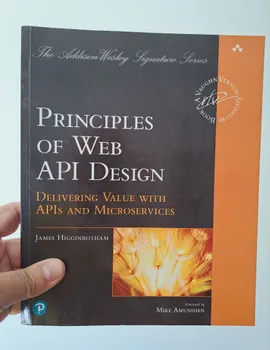
Principles of Web API Design: Delivering Value with APIs and Microservices by James Higginbotham is a well‑known, modern, full‑lifecycle guide to API design. It was published in December 2021 by Addison‑Wesley and is widely referenced in professional API design circles.
What the book is about
Section titled “What the book is about”-
Outcome‑driven API design
Align stakeholders on specific business outcomes before touching endpoints. -
Job stories & EventStorming
Capture real user needs, activities, and domain events to derive API boundaries. -
API boundary identification
Use bounded contexts, activities, and domain flows to define coherent API profiles. -
Modeling APIs
Sequence diagrams, capability modeling, and prioritization of API reuse. -
REST, RPC, GraphQL, async/event‑driven styles
Clear guidance on when each style fits, including streaming and messaging patterns. -
Refining & evolving APIs
Developer experience, documentation, testing strategies, and designing for change. -
Microservices decomposition
How APIs relate to microservices and how to split services safely.
Core takeaway
Section titled “Core takeaway”Higginbotham teaches a structured, outcome‑driven API design process (Align → Define → Design → Refine) that blends DDD, EventStorming, job stories, and multiple API styles (REST, RPC, GraphQL, async/event‑driven). It’s one of the most practical books for designing APIs as products.
Why it matters
Section titled “Why it matters”It’s one of the few books that:
- Treats API design as a collaborative product discipline, not just a technical exercise.
- Provides a repeatable process you can apply in real projects.
- Covers multiple API styles with practical examples.
- Connects API design to microservices architecture, developer experience, and long‑term maintainability.